
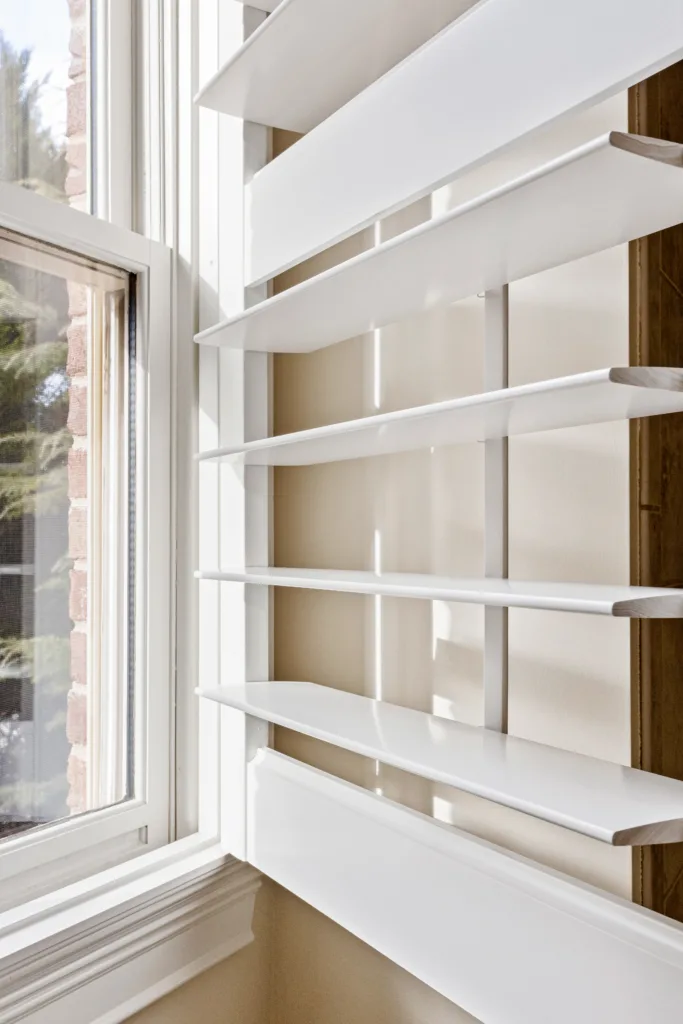
One of the smaller decisions in a plantation shutter order ends up making a bigger visual difference than most homeowners expect: how the louvers actually tilt open and closed. A hidden tilt bar shutter conceals the mechanism inside the frame for an unbroken view of the louvers, while a traditional front tilt bar sits in plain sight down the center or side of the panel. Both work well, but they solve different priorities. At Castleberry Shutters, we build both styles by hand in our Woodstock, Georgia workshop, and we walk every customer through the tradeoffs before production starts.
What a Front Tilt Bar Actually Does
The front tilt bar is the classic, time-tested mechanism most people picture when they think of plantation shutters. A vertical bar runs down the face of the panel, connected to each louver through small metal pins. Pushing the bar up or down tilts every louver in that section at once, giving you fast, uniform control over light and privacy.
Front tilt bars are simple, durable, and easy to operate by hand, which is part of why they’ve remained popular for decades. They’re also generally the more budget-friendly of the two mechanisms, since the hardware and installation process are more straightforward. The tradeoff is purely visual: the bar is visible on the front of the panel and interrupts the clean lines of the louvers, which some homeowners don’t mind at all and others would rather avoid.
How a Hidden Tilt Bar Shutter Changes the Look
A hidden tilt bar shutter, sometimes called a rear tilt or clearview mechanism, moves the connecting hardware behind the louvers instead of across the front. From the front of the panel, all you see are clean, uninterrupted louvers with no visible bar running through the middle. This creates a more streamlined, modern appearance and gives you a slightly clearer view through the shutter when the louvers are open, since there’s no bar breaking up your sightline.
Functionally, a hidden tilt bar shutter still allows you to adjust the full row of louvers together; the mechanism is simply relocated rather than removed. Some hidden tilt systems also allow for smoother, more even louver movement since the connection points are more evenly distributed across the panel.
Which Style Fits Your Home?
Front tilt bars tend to suit traditional or classic interiors, especially in homes where the shutter style itself is meant to read as a period-appropriate architectural detail rather than disappear into the background. They’re also a practical choice for homeowners who want reliable, no-frills function without paying for the added hardware of a concealed mechanism.
Hidden tilt bar shutters tend to appeal to homeowners with more contemporary or transitional interiors, or anyone who wants the cleanest possible look on a larger window where an unbroken view matters, such as a living room window facing a backyard or garden. They’re also a popular upgrade on French doors and sliding door panels, where an unobstructed view through the glass is often part of the point.
Durability and Maintenance Differences
Both mechanisms are built to last when installed correctly, but they do differ slightly in long-term maintenance. Front tilt bars are simpler mechanically, with fewer moving parts hidden from view, which can make it easier to spot and address wear over time. Hidden tilt bar shutters rely on an internal mechanism that, while durable, is less visible for a quick visual check, which is one more reason to work with a manufacturer who builds and can service the hardware directly rather than through a third party.
The Castleberry Approach to Tilt Bar Selection
Every shutter we build starts with a conversation about how you’ll actually use the room, not just which style photographs best. Our team can walk you through both mechanisms in person, using real panels so you can feel the difference in operation, not just see it in a picture. You can learn more about our full lineup of real-wood plantation shutters, including both tilt options, on our plantation shutters page, and see finished examples of each style in our project gallery.
The plantation shutter itself has a long design history, evolving from functional, louvered window coverings into the customizable, mechanism-driven product available today, a history worth understanding if you’re comparing plantation shutter styles for the first time.
Key Takeaways
- A hidden tilt bar shutter conceals the operating mechanism behind the louvers for a clean, uninterrupted front view, while a front tilt bar is visible on the panel’s face.
- Front tilt bars are simpler, more budget-friendly, and easier to visually inspect over time.
- Hidden tilt bar shutters suit contemporary interiors, larger windows, and doors where an unobstructed view matters most.
- Castleberry Shutters builds both tilt styles in-house and helps homeowners choose based on room use, not just appearance.
FAQ: Hidden Tilt Bar Shutters
Is a hidden tilt bar shutter harder to operate than a front tilt bar? No. Both mechanisms let you tilt an entire row of louvers together; the hidden version simply relocates the connecting hardware out of view.
Does a hidden tilt bar shutter cost more? Typically, yes, since the concealed mechanism requires more precise hardware and construction than a standard front tilt bar.
Can I mix tilt bar styles in the same room? Yes, though most homeowners choose one style per room for a consistent look, especially when shutters are visible from multiple windows at once.
Which tilt style is better for French doors? Hidden tilt bar shutters are popular for French doors and sliding doors since they preserve an unobstructed view through the glass.
If you’re deciding between a hidden tilt bar shutter and a classic front tilt bar, reach out to Castleberry Shutters for a free in-home consultation. We’ll bring samples of both so you can compare the look and feel before you decide.