
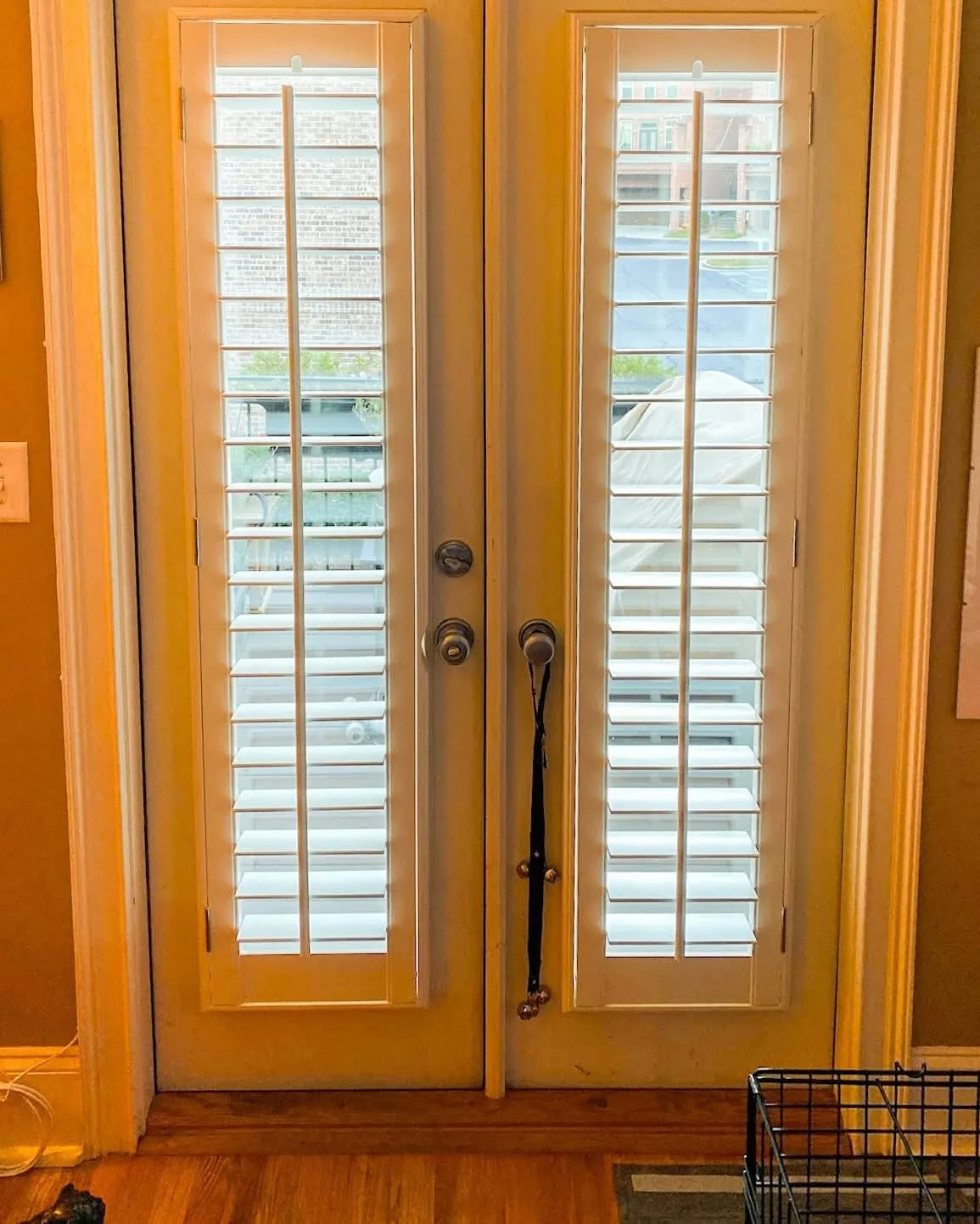
Plantation shutters are often thought of as a window treatment, but some of the most impactful installations we do at Castleberry Shutters are on doors. French doors, sliding glass doors, and the narrow sidelight windows next to front entries all present a different challenge than a standard window. The shutter still needs to look great, but it also has to work with the door’s hardware, hinges, and daily use without getting in the way. Here’s how we approach shutters for doors and what makes it different from a standard window installation.
Why Doors Require a Different Approach
A window shutter only has to open, close, and tilt. A door shutter has to do all of that while the door itself is opening, closing, locking, and being walked through multiple times a day. That means clearance, hardware placement, and durability all matter more on a door than they do on a typical window.
French doors need shutters that won’t interfere with the door handle or hinge swing. Sliding doors need a solution that can handle a wide track without the shutter panels binding or rattling. Sidelights, the narrow glass panels often found next to front doors, need a scaled-down design that still matches the look of shutters elsewhere in the home. Getting any of this wrong results in a shutter that looks great standing still but becomes a daily annoyance.
French Doors: Frame-Mounted for Full Function
For French doors, we typically recommend mounting the shutter frame to the door itself rather than to the surrounding wall or window frame. This keeps the shutter moving with the door as it opens and closes, rather than creating a situation where the door swings but the shutter stays put and blocks the opening. Door-mounted shutters are built with smaller, often narrower louvers, commonly in the 2.5 inch range, to keep the panel lightweight and properly scaled to the door’s glass insert.
Hardware placement is critical here. We plan louver and panel size around the door’s existing hinges, handle, and lock so nothing binds or rubs during normal use. The goal is a shutter that looks like it was designed for the door from the start, not added on after the fact.
Sliding Doors: Balancing Coverage and Clearance
Sliding glass doors present their own puzzle because of their width and the mechanics of the track system. A bank of shutter panels needs to be able to bi-fold or slide out of the way cleanly when the door is in use, without any panel catching on the track or the door frame. We typically use a bi-fold panel configuration, sometimes paired with a wider frame that accommodates the door’s stationary and moving panels differently.
Because sliding doors are often a home’s main connection to a patio, deck, or backyard, they also get more daily use and more direct sun exposure than most windows. We factor both of those into the wood selection and finish to make sure the shutters hold up over years of regular use, not just months.
Sidelights: Small Scale, Full Detail
Sidelights are often the trickiest door application because they’re narrow, sometimes only a few inches wide, but homeowners still want them to match the plantation shutters used elsewhere on the home’s exterior or entryway. We custom-build these panels to the exact dimensions of each sidelight, typically using smaller louvers and a simplified frame that fits the tight space without looking cramped or mismatched next to the front door’s larger shutters.
Because sidelights are so visible from the street, we pay particular attention to matching stain or paint color exactly to the rest of the home’s shutters, so the whole entry reads as one cohesive, custom look rather than a patchwork of different treatments.
Privacy, Light Control, and Curb Appeal
Beyond function, shutters on doors solve a problem a lot of homeowners don’t think about until they move in: glass doors offer very little privacy and a lot of unwanted afternoon heat and glare. Shutters give you the ability to control both without covering the door in heavy drapery or losing the architectural detail of the glass altogether. Tilting the louvers lets in filtered light while keeping the interior private from the street or a neighboring yard, and closing them fully during peak afternoon sun helps cut down on heat gain.
From a curb appeal standpoint, shutters on French doors and sidelights also tend to elevate a home’s entryway more than almost any other single design choice, since they’re one of the first things a visitor sees.
The Castleberry Approach
Every door shutter we build starts with an in-home measurement, not a generic template. We look at the door’s swing, hardware, and hinge placement before recommending a panel configuration, and every piece is handcrafted in our Woodstock workshop from American-grown white poplar, just like our window shutters. Because we handle both manufacturing and installation, the same team that builds your door shutters is the team making sure they operate smoothly on install day, and every one is backed by our lifetime guarantee.
If you have French doors, sliding doors, or sidelights that could use the same custom shutter treatment as the rest of your home, reach out to Castleberry Shutters. We’ll come out, take a look at your specific doors, and build a solution that fits and functions the way it should.